Overview
Global Green Energy Limited (GGEL) is one of the upcoming renewable energy companies in India with a promise to provide a better, cleaner and greener future for India. Driven by the philosophy of ‘Growth with Goodness’, the company develops, builds, owns, operates and maintains utility-scale grid-connected solar, wind farm projects, including ethanol, bio-CNG and hydrogen gas.
The electricity generated is supplied to Central as well as State government entities and government-backed Corporations. Its vision is “Powering Bharath by the Power of Nature”.
GGEL accelerates the adoption of renewable technology across India to conserve environment, provide an environment friendly and sustainable source of energy through economical and sustainable, renewable energy generating models to its customers and thereby replacing energy sourced from fossil fuels to renewable energy.
The GGEL core values includes ethical, equal opportunity to all, respect for the individual, transparency, respect for Diversity and Environmentalism.
GGEL intends to establish Center of Excellence as one of its promoters to extend support for Research and Development to lower costs and increase efficiency. The Centre also intends to engage in R & D work in the domain of fuel cells and energy-based fuels.
About CIT
Established in 2007 under the aegis of Umesh Education Trust, is a premier UGC certified Autonomous Institution affiliated to Visvesvaraya Technological University (VTU) – Belagavi, recognized by Government of Karnataka and approved by AICTE – New Delhi.
The Institute is accredited by NAAC with A+ grade and has four study programs accredited by NBA. It is certified by the Department of Science and Technology (DST), Government of India as a Scientific and Industrial Research Organization (SIRO).
CIT serves as a Host Institute under MSME, Government of India, for the implementation of the Incubation Component for Start-ups.
The Institute offers nine undergraduate, four postgraduate programs and eight Ph.D. programs. Government funded research projects worth ₹45 Crores are being executed alongside consultancy projects worth ₹50 Lakhs are being carried out in collaboration with leading industries that include Fortune 500 companies.
The Institute has strong industry collaborations with organizations such as Samsung, Synopsys, and EOS.
Objectives
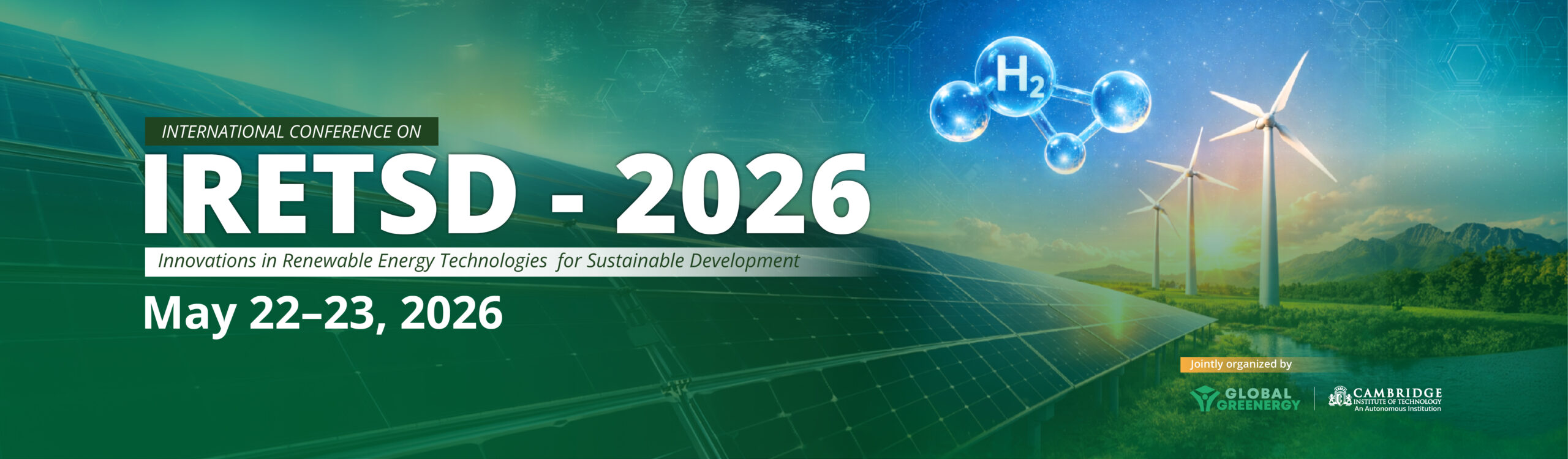
The Conference aims to address the Sustainable Development Goals (SDGs) focused on fossil fuel conservation and environmental preservation, thereby contributing to climate change mitigation and promotion of renewable energy systems.
It serves as a platform for:
a. Collaborative Knowledge Sharing: Through diverse scholarly events to showcase innovative research in the domain of renewable energy.
b. Expert Engagement: Leading Scientists and researchers will gather to exchange insights on hydrogen energy and related cutting edge technologies.
c. Interdisciplinary Platform: Participants will discuss innovations and trends, fostering collaborative solutions to practical challenges in renewable energy sector.
Thrust Areas of the Conference
- Renewable Energy Technologies – Focus on innovations in solar, wind, hydroelectric, hydrogen and geothermal technologies that are essential for the transition to sustainable energy systems.
- Energy Efficiency and Conservation – Explore strategies that improve energy efficiency across industries and households, significantly reducing energy demand and promoting conservation practices.
- Sustainable Fuels and Green Chemistry – Investigate the development of sustainable fuels like biofuels and hydrogen, emphasizing green chemistry principles that minimize environmental impacts.
- Climate Change and Environmental Impact of Energy Systems – Examine the relationship between energy systems and climate change, and promote practices that reduce greenhouse gas emissions for sustainability.
- Innovative Energy Materials and Technologies – Discuss advancements in materials science that enhance renewable energy technologies, focusing on collaboration for breakthrough innovations.
- Energy Policy, Economics, and Social Impacts – Analyze effective policies that drive the renewable energy transition while ensuring equitable access and acceptance within communities.
- Biodiversity Conservation – Address the importance of protecting biodiversity in maintaining health of ecosystem and integrate these considerations into energy planning.
- Sustainable Resource Management – Explore efficient management practices that balance resource extraction with conservation to achieve sustainability goals.
- Pollution Control and Waste Management – Discuss innovative technologies for reducing pollution and managing waste, contributing to a more sustainable circular economy.
- Climate Change Mitigation and Adaptation – Develop strategies for mitigating climate change effects while enhancing community resilience through renewable energy solutions.
- Ecological Restoration and Rehabilitation – Investigate techniques for restoring damaged ecosystems to promote biodiversity and sustainability in affected areas.
- Environmental Management Systems – Present best practices for implementing effective environmental management systems that ensure compliance and promote sustainability.